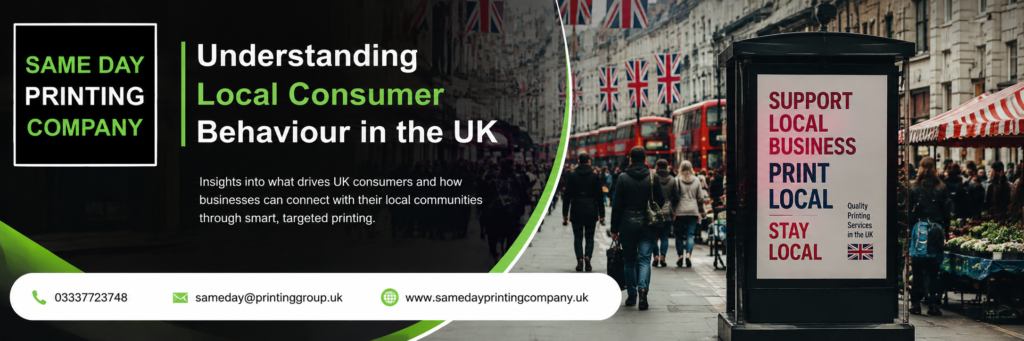
Understanding how people choose where to shop, what to buy and which businesses to trust is important for any organisation operating in the UK. Consumer behaviour is not the same everywhere. People living in central London may have different routines from customers in Manchester, Birmingham, Cardiff, Glasgow or a smaller market town.
Local habits are shaped by factors such as transport, working patterns, shopping areas, community life, household budgets and the type of businesses available nearby. For companies planning local marketing, these differences matter.
At same day printing company, we see how printed materials can support businesses that need to communicate with customers in their own areas. A flyer for a local event, a poster outside a shop or printed workwear for a service team all work differently depending on where and how people will see them.
Local Shopping Habits Vary Across the UK
The UK has a mix of major city centres, suburban shopping streets, retail parks, traditional high streets and local markets. This means there is no single way to reach every UK consumer.
In busy city centres, customers may pass shops, cafés, restaurants and service businesses while travelling to work or using public transport. Clear signs, window posters and short printed messages can work well because people often have limited time to read them.
In smaller towns and residential areas, local businesses can have more regular contact with the same customers. A leaflet delivered to homes or a flyer available at a community venue may remain useful for longer.
Businesses should therefore think about where their customers spend time before choosing a marketing format. Flyer printing may suit a short local campaign, while brochure printing can be more appropriate when customers need detailed information before making a decision.
The UK High Street Still Has a Local Role
High streets across the UK contain a wide range of independent shops, cafés, restaurants, salons, estate agents, professional services and national chains. Their exact mix varies from one place to another, but physical visibility remains important for businesses serving people locally.
Printed communication can support this visibility without making the message complicated. A poster in a window can show opening hours, a new service or an upcoming event. Leaflets can explain prices or services. Business cards can help customers keep contact details after visiting a business.
This is where printing services in the UK can support both regular and short-term communication. Businesses do not always need a large campaign. Sometimes a small batch of posters, menus, cards or leaflets is enough for a particular area or customer group.
The important point is to match the printed item to the way customers actually use the local area.
Convenience Affects Customer Decisions
Convenience is an important part of everyday consumer behaviour. UK customers often compare businesses based on practical points such as location, opening hours, availability, delivery and how quickly they can get what they need.
Transport can also affect this behaviour. London has an extensive public transport network, while customers in other parts of the UK may depend more heavily on cars, local buses or regional rail services. Businesses based near railway stations, shopping centres and busy town centres may deal with customers who are already travelling through the area.
Clear printed information can make decisions easier. Posters can communicate offers or opening times quickly, while banners can help people identify a business, event or temporary location from a distance.
For urgent campaigns, same day printing can also be useful. A restaurant may need updated menus, an organiser may need event posters, or a shop may need signs for a weekend promotion. Quick production allows businesses to respond to changes without relying on materials prepared weeks earlier.
Community Connections Influence Local Marketing
Many UK towns and cities have active community groups, schools, charities, sports clubs, places of worship, local organisations and independent businesses. Events such as school fairs, seasonal markets, exhibitions, charity activities and community meetings create opportunities for organisations to speak directly with local residents.
Printed materials are particularly useful in these settings because they can be placed where the intended audience already spends time.
Flyer printing can support event promotion, while poster printing can provide information at shops, cafés and community venues where permission has been given. Banner printing may be useful at larger events, and booklet printing can provide programmes, schedules or detailed visitor information.
Businesses can also build local recognition through practical branded items. T shirt printing may be suitable for event teams, while workwear printing can help staff from trades, delivery services and other local businesses appear easy to identify when working with customers.
The aim should be clear communication rather than putting a business name on every possible item.
Printed Marketing Should Match Customer Needs
Consumer behaviour can change depending on the type of purchase being considered. Someone choosing a takeaway may make a decision quickly, while a person looking for a builder, wedding supplier or professional service may spend more time comparing options.
Printed marketing should reflect this difference.
A short leaflet can work well when the customer mainly needs a list of services, contact details and opening information. A brochure may be better for a business that needs to explain several services, show previous work or provide more detailed information.
Business card printing also remains practical for face-to-face situations such as meetings, exhibitions, networking events and local business visits. Customers can keep the details without needing to search for the company again immediately.
Large format printing has a different purpose. Posters, banners and display graphics need to communicate from a greater distance, so the message should normally be shorter and easier to read.
Before ordering any printed material, businesses should ask a simple question: what does the customer need to know at this point?
Combining Local Knowledge With Print Marketing
Good local marketing starts with understanding the area rather than simply printing more material. A business serving office workers in a city business district may need a different approach from one serving families in a residential suburb.
The same applies across England, Scotland, Wales and Northern Ireland. Population size, transport, shopping habits and local business activity vary considerably, so campaigns should be planned around the actual audience.
Businesses can begin by looking at where enquiries come from, which services local customers request and when demand increases. They can also pay attention to local events and seasonal changes that are directly relevant to their work.
Once the audience is understood, print becomes easier to plan. Leaflets can be distributed in suitable areas, posters can be placed where customers are likely to notice them, and brochures can be given to people who need more information.
This approach can also reduce waste. Instead of printing large quantities without a clear purpose, businesses can choose suitable quantities, formats and locations for each campaign.
Conclusion
Understanding local consumer behaviour in the UK means recognising that customers make decisions within their everyday surroundings. High streets, shopping centres, workplaces, residential areas, community venues, transport links and local events all affect how people discover and interact with businesses.
Printed marketing works best when it fits these real habits. Business cards, flyers, leaflets, posters, banners, brochures and printed clothing each have a different role.
For same day printing company, the practical focus is helping businesses choose print that supports a clear purpose. By considering who the customer is, where they are likely to see the message and what information they need, UK businesses can make local print campaigns more relevant and useful.